THE RAPTURE OF EXIT

Is Silicon Valley planning its escape from democracy?

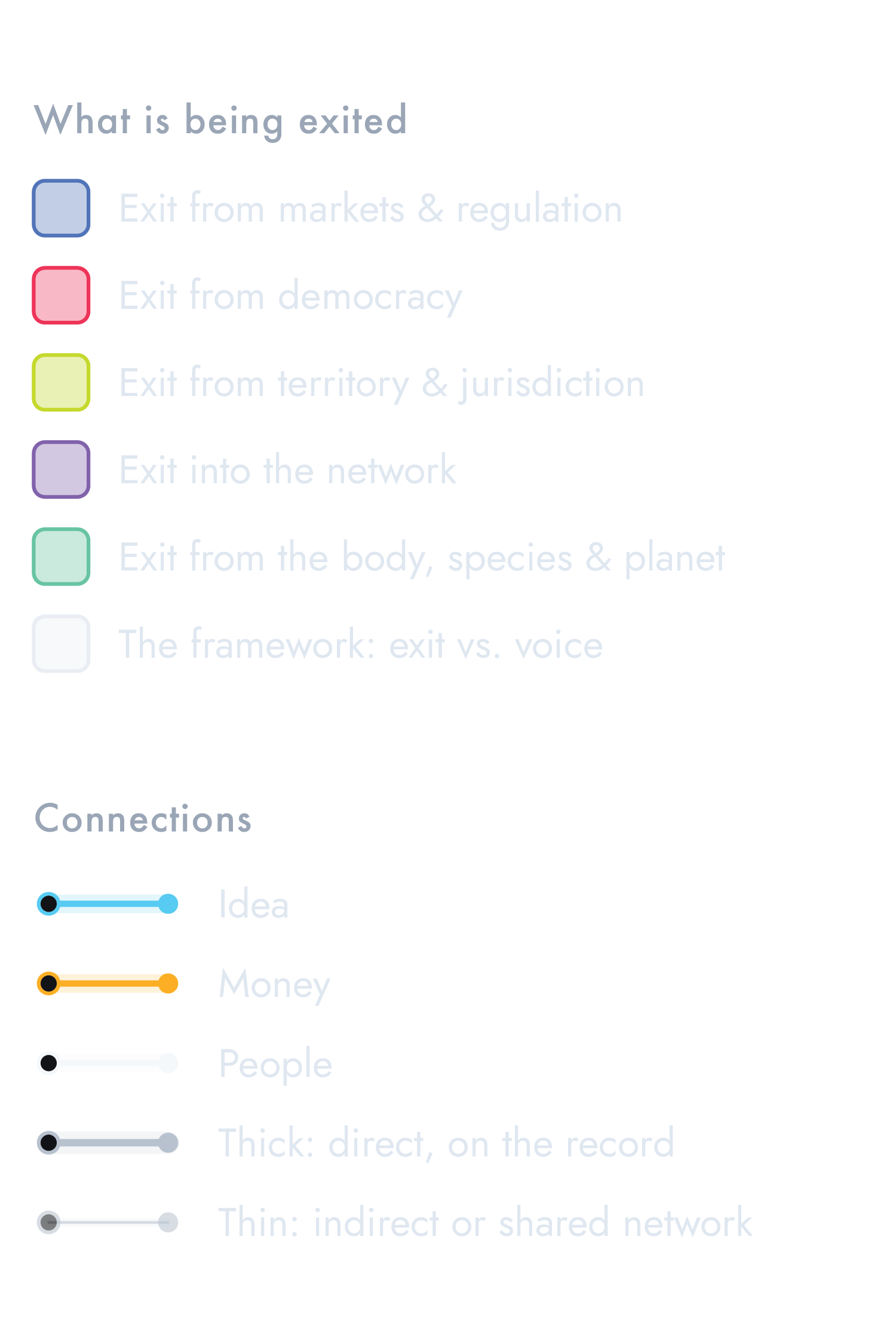
In 1970, the economist Albert Hirschman described two ways people respond when an institution fails them: they can leave, or they can stay and push for change. He called these exit and voice. Over the following half century, a loose network of philosophers, technologists, and investors carried the idea of exit well beyond anything Hirschman described, into floating cities, charter zones, private governments, online nations, and the merging of humans with machines. This chart traces that lineage from 1942 to 2026, showing who drew on whose ideas, who funded whom, and who worked alongside whom.
Video Essay Introduction by Malcolm Wyer: click here.

1950 1960 1970 1980 1990 2000 2010 2020 1942 Joseph Schumpeter Creative destruction 1957 Ayn Rand Galt's Gulch 1961 John Cowperthwaite Exit without leaving 1970 Albert Hirschman Leave, or stay and fight 1973 FM-2030 Exit from the body 1974 Robert Nozick A framework for utopia 1990 Burning Man Anarchy, built — and un-built 1993 Cypherpunks Privacy through code 1996 John Perry Barlow Independence of cyberspace 1998 Bostrom & Pearce Respectable exit 2002 Musk founds SpaceX Exit the planet, then the bureaucracy 2007 Curtis Yarvin (Moldbug) Neocameralism 2009 Patri Friedman Beyond folk activism 2009.6 Peter Thiel Freedom or democracy, not both 2010 Paul Romer Rules you can opt into 2012 Nick Land The Dark Enlightenment 2013 Balaji Srinivasan Silicon Valley's ultimate exit 2017 Próspera The charter city, built 2018 Titus Gebel Free private cities 2023.5 Buterin's Zuzalu A (non) Burning Man 2023.9 Marc Andreessen Techno-Optimist Manifesto 2024.3 Sam Altman The Merge 2026.1 David Sacks Exit California 2026.7 Praxis 87,000 citizens to a landing site